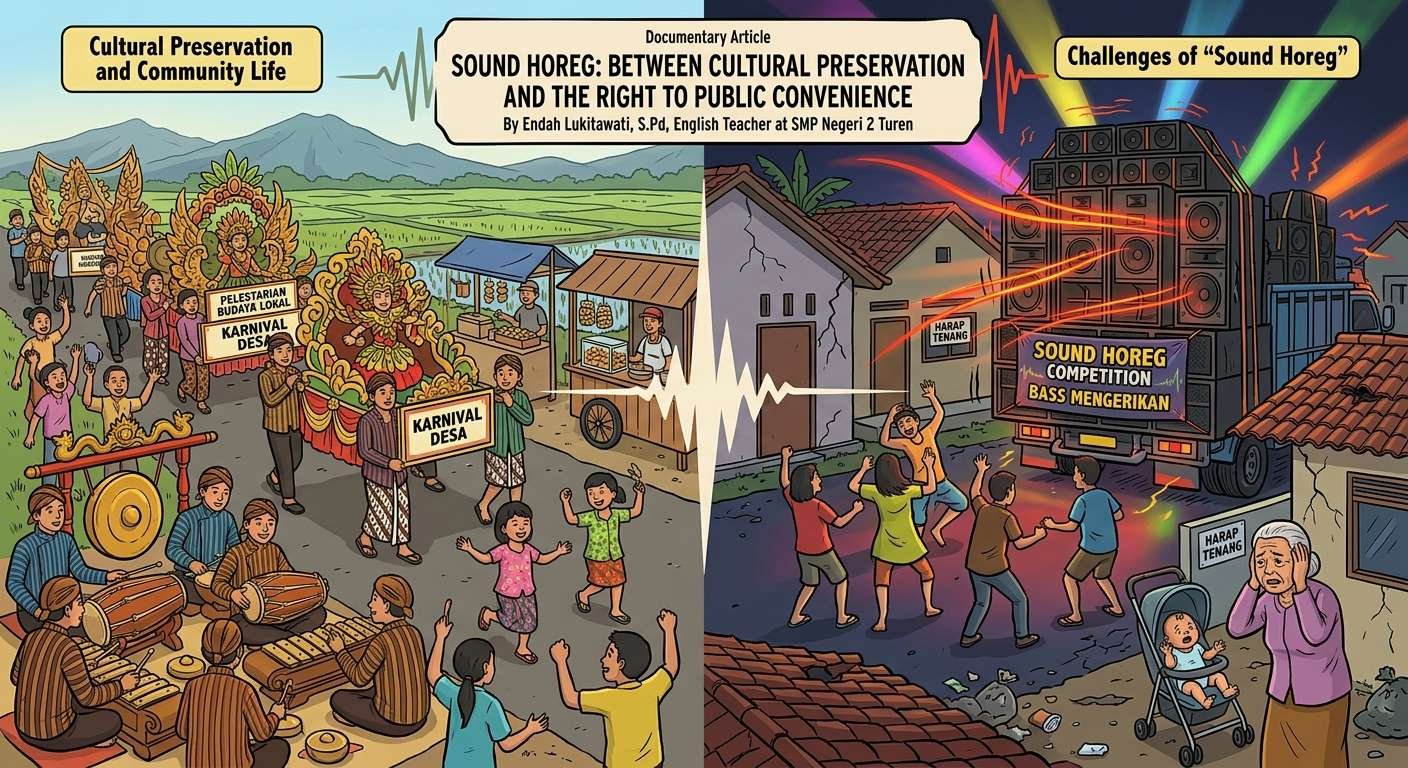
Sound horeg is increasingly used at
various community events nowadays such as Independence Day celebrations, the
Islamic New Year, and village clean-up days, which are celebrated annually.
Initially, villagers used trucks to transport sound systems that accompanied
village carnivals and parades. As this practice evolved, a new trend emerged in
the community known as “sound horeg.” The term “horeg” itself comes from the
Javanese language and means “to vibrate” or “to move,” while “sound” comes from
English. In essence, “sound horeg” refers to a loud, thunderous sound that creates
vibrations in the surrounding area, causing the audience’s hearts to race. The use of sound systems—which tends to be
extreme due to their high sound output—has become increasingly popular through
social media. This “sound horeg” culture emerged from the creativity of local
audio communities in East Java, particularly in areas like Malang, Sidoarjo,
Surabaya, Banyuwangi, and Blitar, as they assembled their own loudspeakers.
As times have changed, the use of “sound
horeg” has undergone a shift in value. The emergence of competition among
villages to rent increasingly expensive sound systems that produce loud,
thunderous sounds has become a source of pride and attracts crowds from various
regions eager to enjoy the bass sounds that makes the buildings and the
listeners’ hearts tremble. The rental price for a sound system varies depending
on the quality and capacity of the system; for the highest-quality systems, the
rental price ranges from hundreds to tens of millions, depending on the
renter’s budget. Some villages collect donations from residents to rent these
sound systems. The carnival becomes lively, and many vendors take advantage of
this opportunity to sell food and drinks. Renting out parking lots also brings
in significant profits for some people. Whereas carnivals or parades used to
run from morning until afternoon, these events now take place from the
afternoon until the early hours of the morning because the colorful spotlights
installed look especially attractive at night. At first glance, it resembles a
mobile nightclub, as some spectators join the carnival participants in dancing
to the music being played. In the past, cultural carnivals showcased
traditional and national culture accompanied by simple regional and national
songs, but now the music has evolved into remixed tracks with extremely loud
bass beats and thunderous subwoofers.
In addition to entertaining and boosting
the local economy, “sound horeg” has also had negative impacts on the
environment. Several incidents have reported that the vibrations from “sound
horeg” have caused buildings to crack, roof tiles to fall, and even walls to
collapse, crushing residents and resulting in fatalities. The loud noise
produced by carnival sound systems can also cause hearing damage or even permanent
deafness, as the sound levels can reach 120 to 135 decibels (dB)—far above the
safe threshold for human hearing, which is 85 decibels (dB). The high-intensity
sound vibrations can also trigger increased heart rate, stomach problems, and
insomnia. Therefore, it is recommended that the elderly, infants, and those
with heart conditions take precautions before the carnival begins to prevent
any unwanted incidents. It is not uncommon for large amounts of trash to be
left behind by spectators after the carnival, leaving the area filthy and
unsanitary. Another negative aspect that often accompanies the “sound horeg”
tradition is the presence of alcohol and erotic dances, which are presented as
part of the “sound horeg” performance and act as a draw for some spectators.
Meanwhile, the audience includes teenagers and even young children, who are not
yet able to process the information they see and may even imitate what they
witness.
The “sound horeg” phenomenon remains a
point of contention among the public. While some support it, others reject the
use of “sound horeg” due to its harmful effects on the community. However, to
date, no regulations have been enacted by the local government to address this
issue. East Java Governor Khofifah Indar Parawansa stated on one occasion that
the East Java government is still identifying the appropriate legal
framework—whether in the form of a Circular Letter, a Regent’s Regulation, or a
Joint Circular Letter—which will be discussed with relevant parties, and noise
regulations will also be incorporated into the recitals. Regulations are
crucial for ensuring the safety and comfort of the community’s environment.
According to M. Febriyanto Firman Wijaya, a lecturer at Muhammadiyah University
of Surabaya, the government can encourage sound system operators to use
environmentally friendly technology that complies with noise standards. The use
of traditional musical instruments in parades or carnivals could be considered
as part of cultural preservation efforts. For example, the use of
gamelan instruments, flutes, trumpets, and gongs played live, combined with
harmonious arrangements—as seen in traditional Balinese ceremonies—has proven
to be a unique attraction for tourists without causing noise or damage.
Educational themes and the use of traditional costumes also help foster
creativity among the community and enhance the appeal of diverse local
cultures, as demonstrated in the Jember Carnival.
We
have to work together to uphold the noble values embedded in our local
traditions and culture so that they are not further eroded by technology and
foreign cultures that are increasingly flooding in through social media and the
internet. Local culture doesn’t have to be presented with thunderous sounds; it
should be presented not only as entertainment but also as a positive lesson
that young people can enjoy.
